 Trump Signal Index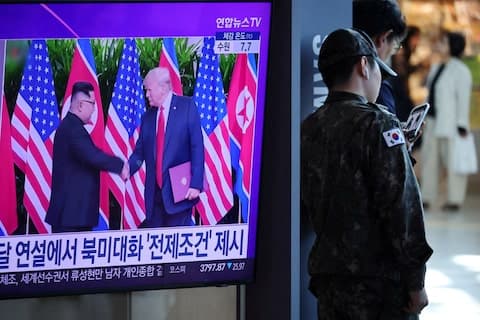
Trump told aides in a private meeting that he wants a summit with Kim Jong-un arranged around the APEC leaders’ gathering in Shenzhen, China — scheduled for November 18-19, according to the WSJ. No official plan has been prepared. The instruction is at the encouragement stage: Trump pushing his staff to make it happen, not a confirmed engagement.
North Korea’s response has been cold. Despite Trump ordering a “drastic reduction” of US-South Korea joint exercises as a goodwill gesture days earlier, Pyongyang issued a statement threatening to respond to what it called “hostile acts” with “new force.” The reduction did not produce the reciprocal signal Trump appeared to expect.
Why North Korea Is Unlikely to Engage
US officials and analysts offer a consistent assessment: North Korea has little incentive to come to the table.
Pyongyang is already a nuclear-armed state. China and Russia have provided economic relief that has softened the impact of international sanctions. The leverage that made the 2018-2019 diplomacy possible — maximum pressure — has eroded. North Korea does not need a deal the way it did eight years ago.
Trump met Kim three times during his first term — Singapore (2018), Hanoi (2019), and the DMZ (2019) — without achieving substantive progress on denuclearization. The Hanoi summit collapsed when the US rejected North Korea’s demand to lift all sanctions in exchange for partial denuclearization. There has been no formal engagement since.
Trump also sought a Kim meeting at last year’s APEC summit in Gyeongju, South Korea. It did not happen.
The pattern is consistent: Trump seeks a meeting with Kim as a visible diplomatic event; North Korea’s price for engagement involves concessions (sanctions relief, exercise cancellations, alliance commitments) that the US is unwilling or unable to deliver permanently. The APEC push in Shenzhen adds a new dimension — the meeting would take place in China, giving Beijing structural involvement in any North Korea diplomacy that emerges. For Xi Jinping, a Trump-Kim summit hosted within China’s borders would be a significant geopolitical win.
The Iran Exit Problem
The diplomatic motive is not subtle. Trump has no exit from the Iran conflict. He said explicitly that there are no ongoing or planned talks with Tehran. The Iran war, which has disrupted Hormuz and kept oil elevated, has consumed foreign policy bandwidth without a clear endgame.
With midterm elections roughly two months away, Trump needs a foreign policy headline that looks like progress. North Korea — where Trump has personal history with Kim and where a summit photograph carries symbolic weight — is the available option.
The calculation: a Kim meeting, even without substantive denuclearization movement, reads as diplomatic engagement in a news environment where Iran offers only stalemate.
South Korea as Scapegoat
Axios reported that South Korea — which Defense Secretary Hegseth had previously cited as a “model ally” — has become an unexpected target of US frustration.
The proximate causes are stacking up:
- South Korea declined Trump’s request to participate in Iran denuclearization efforts (“No thanks”)
- The US-Korea alliance relationship is being publicly destabilized to send signals to Kim
- Seoul is now absorbing the diplomatic cost of Trump’s North Korea pivot without any corresponding benefit
South Korea has no direct role in the Iran conflict and has maintained its alliance commitments. Its emergence as a “scapegoat” reflects the logic of Trump’s foreign policy: allies who are not useful in the current priority theater (Iran) become liabilities in the adjacent theater (Korea), where their security needs complicate Trump’s Kim outreach.
The APEC push for a Kim meeting is structurally weak: North Korea is cold, the venue (China) gives Beijing leverage, and Trump’s prior concession (exercise reduction) produced no reciprocal signal. The diplomatic play is driven by domestic political need — midterm visibility — not by a realistic denuclearization framework. For markets: South Korea faces sustained alliance uncertainty as Trump treats the alliance as a negotiating chip for Kim. The Shenzhen APEC timing means US-China-North Korea dynamics will converge in November in ways that add complexity to any trade or tech policy the US is simultaneously pursuing with Beijing. Geopolitical risk in Northeast Asia is elevated regardless of whether a Kim meeting materializes.
Trump’s Push
Aides told to arrange Kim summit around APEC — Nov 18-19, Shenzhen
Official Status
No plan prepared — encouragement stage only
NK Response
Cold — threatened ‘new force’ despite exercise reduction
Prior Summits
3 meetings in Trump 1st term — zero denuclearization progress
Iran Status
No ongoing or planned talks — Trump confirmed
South Korea
Axios: ‘unexpected scapegoat’ despite being cited as model ally